* Translated by Janine Muller Sherr
Tonight and tomorrow, we will mark the seventh of Adar. Here are five ideas to keep in mind about this special day:
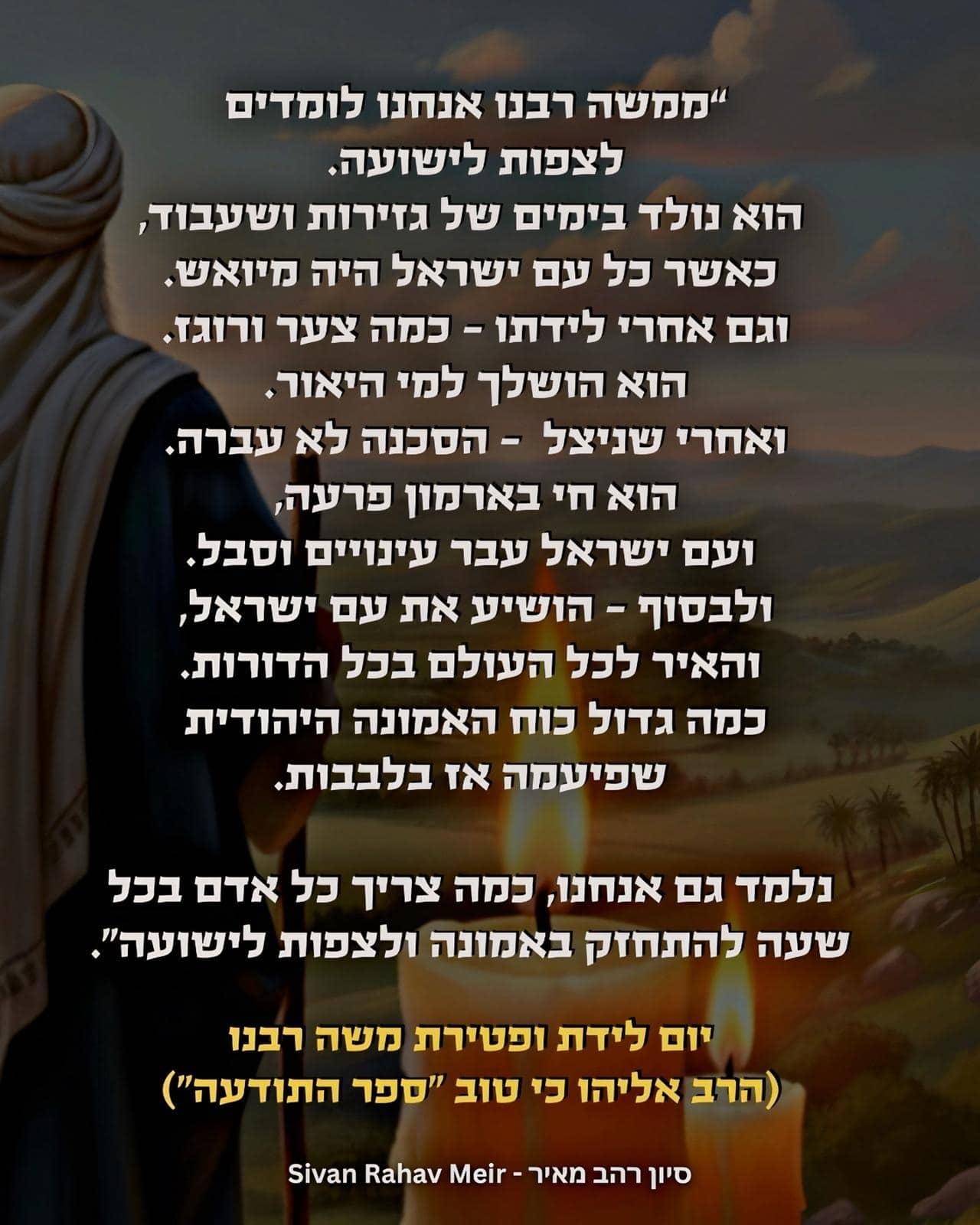
1) The seventh of Adar is the day that Moshe Rabbeinu was born and the day he died. Notice that we naturally refer to him as Moshe *Rabbeinu*, our teacher, as he continues to be our teacher until this day.
2) On the yahrzeit of a righteous person, it is customary to pray, study his teachings, and light a candle in his memory. I invite you to do so tonight. Every verse we read in the Torah is part of what he taught us.
3) There is so much we can learn from Moshe Rabbeinu’s exceptional character. God Himself testifies in the Torah that Moshe Rabbeinu was the most humble man on the face of the earth, and that there was never another prophet who was closer to God. Our greatest leader also had a speech impediment: He was “chevad peh u’chevad lashon”—heavy of mouth and heavy of tongue.” Finally, it is important to note that the impact of this lofty man of spirit was more far-reaching than any political or military leader, media personality, or academic who ever lived. In the end, it is the influence of a spiritual leader that has endured for all time.
4) Moshe faithfully led the people through the desert for forty years but never heard the words: “You have reached your destination.” He died and was buried before the people entered the Holy Land. His life story teaches us that achieving our goals is not the only thing the matters, but that the journey, the effort, the hope that propels us forward, are meaningful too and that our life’s work may be completed by others. Our story is larger than our lives and will continue to grow and bear fruit when we are no longer here.
5) The location of Moshe’s grave is unknown. For this reason, the seventh of Adar has become the day on which we remember all those whose date of death and place of burial are unknown, and for all those who never had a Jewish burial. Over the years, this date has become an important one for members of the chevra kadisha—the group of men and women who prepare the body for burial. Some of them have the custom of fasting on this day. It is a day to express our deepest gratitude and appreciation for those who dedicate themselves to this holy work.
In memory of our greatest teacher.