* Translated by Janine Muller Sherr
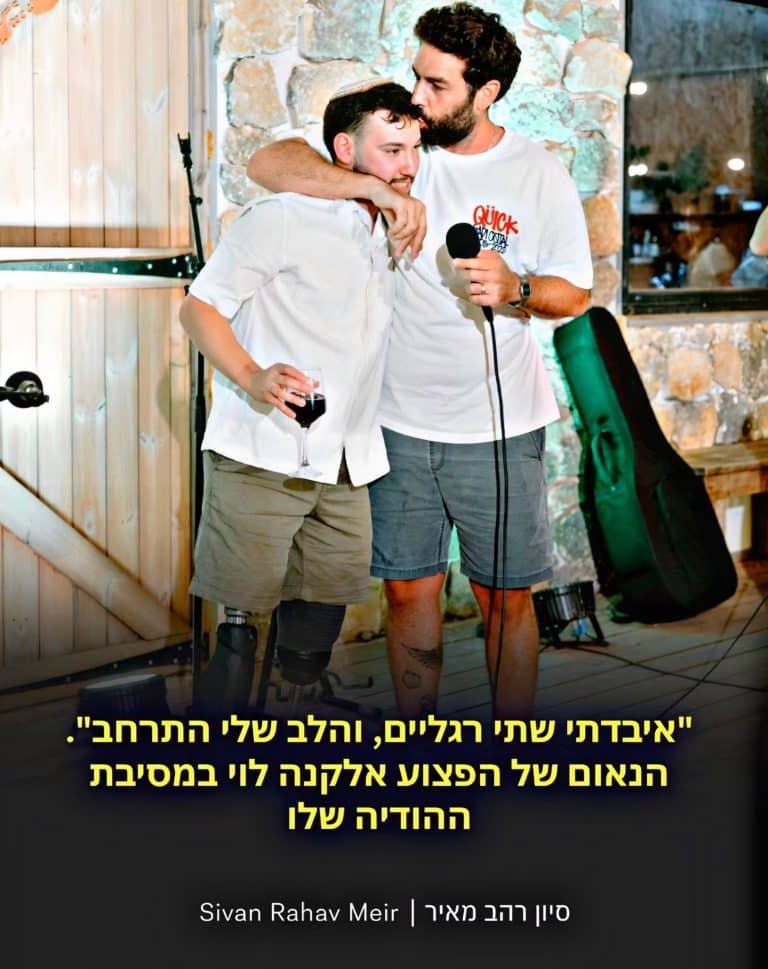
Several days ago, Elkana Levi, a Golani brigade officer, held a celebration of gratitude one year after losing both his legs in an explosion in Khan Younis. You might remember him as "Elkana ben Orit" from our prayers for his recovery.
Recently a video was posted of him at the party with the singer Ravid Plotnick who came to sing for him. We have become accustomed to watching this type of brief but moving video. But then someone urged me to read the entire text of Elkana's speech. The following was the core of his 40-minute speech:
"Exactly one year ago today I was severely injured in an explosion. Exactly one year ago today I wasn't aware of how much good there is in this world," he declared, while standing on his two prosthetic legs. Then he began to elaborate on all the good that he has experienced since his injury.
"There are no words for me to express my deep gratitude for the incredible treatment I received at Soroka Medical Center—from the top physicians to the hospital attendants. In some ways, I felt like I was in summer camp with the most amazing staff. I can fondly recall every person I met there and every experience I had. When I opened my eyes at the hospital, the first thing I saw was a picture sent to me from kindergarten children. And from that day on I have felt embraced by everyone. I no longer have my own legs, but it's hard for me to explain how much my heart has expanded. My happiness is not dependent on the number of steps I can take."
The audience applauded and continued clapping at several points of his speech. It was clear to everyone assembled that he had gone through a therapeutic process that brought him full circle. "When I was in the intensive care unit, I was already dreaming of this celebration. Thank you so much for coming."
He didn't gloss over his pain and suffering. He spoke about his friends who were killed in the war and about his darkest moments. "I feel that people don't understand me and don't even realize that they can't possibly understand what I'm going through. How can people understand what it's like for the batteries of your prosthetics or wheelchair to run out; that you walk around feeling so ugly, and that when you try to sit down, you are not sure if you'll be able to get up again; that when you walk on the street you are treated like a celebrity and everyone feels that they know you; and how you are the center of attention even before you open your mouth."
He acknowledged three spiritual mentors who have guided him through his difficult ordeal:
First, the prophet Yeshayahu (Isaiah) who delivered words of consolation. "Yeshayahu teaches us that God thinks about us with hope, and that He will comfort us. As it says: 'And you shall draw water with joy from the fountains of salvation.' I feel that I'm the recipient of great kindness and salvation and I'm certain that even more salvation awaits us."
Then he mentioned Rabbi Nachman of Breslov, who often wrote about the importance of gratitude, of focusing on the good. Elkana reviewed each stage of his journey—from the time of his injury until today—and thanked everyone who supported him along the way. He also expressed his gratitude to…his legs.
"I want to thank those who are not here with us today—my precious legs. I want to thank you for 23 years of love and devotion. I didn't realize how hard you were working all these years. When I travel around the country, everything looks familiar to me and I thank you for carrying me through so many trips, and for the parts of you that remain with me so that I can continue to 'walk before God in the land of the living.'"
And his final source of inspiration was the Tanya, the foundational work of the Chabad movement. Elkana quoted an Aramaic passage, which he then translated into Hebrew, reflecting on his own experience. "In the Tanya there is a passage that encapsulates everything: 'Pain cries out from one side of the heart and joy from the other side.' This is exactly how I feel. Every moment I experience the sensation of not having legs, and that sensation travels throughout my body. On the other hand, I feel so good. This has been one of the best periods of my life. So here is my formula for a good life which I encourage others to follow: learn how to go through the pain and grow from it, how to balance grief and joy at the same time and emerge stronger."
Thank you, Elkana.